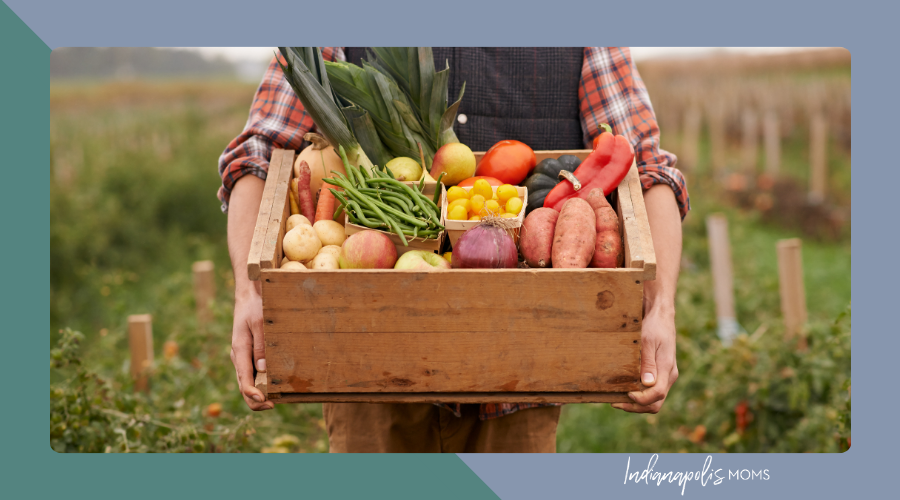
Last year, we joined a CSA here on the westside. Throughout the late spring and summer, every week we picked up a bag of assorted vegetables, fruits, and some sort of surprise: honey, jam, garlic butter, the possibilities were endless for what we would find aside our turnips, apples, tomatoes, cantaloupe, peppers, and kale. It was a positive experience, especially as my kids got more involved in the pick up and consumption. The CSA grew so much more than fresh produce; it grew a sense of community and delight in the outdoors for the urban near westside.
CSA stands for “community supported agriculture.” Think of it as a joint venture for small farms. Members of a CSA pay upfront for fresh produce before the season begins, which provides the capital for the owners of the CSA to plant. The owners then provide all of the labor before, during, and after the growing season. Members then have access to vegetables, fruit, and other harvested materials. CSAs are becoming increasingly popular across urban areas, and access is expanding as small farms pop up.
The CSA we joined was very community-focused, with a goal of providing as many families as possible with fresh produce. Because of this, it had different payment tiers based on income levels. Those who paid into the highest tier, in turn, paid partially into the lowest tier for people with less expendable income, thus creating a culture of interconnectedness within the CSA. Each week, we would get a bag of assorted goods worth between $25 and $30. At the end of the season, our CSA donated almost all of its produce to neighborhood food pantries when food scarcity became a real worry in the face of the government shutdown.
We joined the CSA after learning about it from a friend. She had frequented a farm stand, and when the owners of the farm stand transitioned to a full-on CSA, she was a member of its inaugural year. When the second year came around for new members, we happily signed up. At that time, I had transitioned to a vegetarian diet to try to mitigate the migraines I was getting more and more frequently. (Now, a full year after making this diet change, I would say that cutting meat, at least in my experience, has been almost life-changing regarding the headaches and migraines I used to get.) I was hoping that the CSA would provide new vegetables and recipes to expand my then-growing plant-based lifestyle. I was also looking forward to being a part of something special on the west side, and it did turn out to be an incredibly special experience.
The CSA we joined is situated firmly on the west side. Within five minutes, there is a Walmart to its east, a Meijer to its south, and Pike High School to its north. Directly next to it are urban fixings: neighborhoods, apartment complexes, I-465, the chaos of 65. Somehow, there are a few acres that sit right in the midst of all that zoned agricultural. On those acres sits a big farmhouse with a front porch swing, a chicken coop, some small outbuildings, and multiple small fields. A trip to the CSA is a trip for the senses. You hear and see the swell of insects and pollinators over a half-acre of wildflowers covering a field left to fallow, their colors purples, blues, yellows, and all shades of green. For smell, there are options, some better than others: fresh cut grass versus manure, based on what the owners have been working on. You touch the veggies that have been laid out on a table for your evaluation and choice, and you feel the cool shade on your back and the sun as it peaks through as you catch up with the other members and the owners before you go on your way for another busy week. Lastly, you taste: this one, a surprise. One time, it was a sweetness of a honey so clear it was almost opaque, not the gold from the supermarket. Another time, a true delight, a slice of vegan green tomato bread. And yet another, as the summer wore on, the crisp first bite of a softball-sized apple. You leave the CSA fulfilled in a way you had not known you needed replenished, and, as an added bonus, you have a bag of fresh produce for the week.
The grand finale of the CSA season was our final pick-up. The owners had set out tables and invited members to stay for a while, rather than the regular midweek grab-n-go. Those of us with kids came prepared with toy bulldozers, shovels, and road graders, the old yellow Tonka ones many of the adults remarked about playing with during their own childhoods (I had found ours at a Goodwill total thrifting win!). The small group of kids played on a large dirt pile, ran up and down a mountain of mulch, dug in a sand pit, and fed small pieces of food to the chickens. As their feet grew dirtier and dirtier, matching the seats of their pants, which had long since shown the wear of a makeshift dirt slide, the owners of the CSA looked on with what could only be satisfaction and gratitude. Here is what they had spent the season working for: the crops, the community. They had sown their own vision.