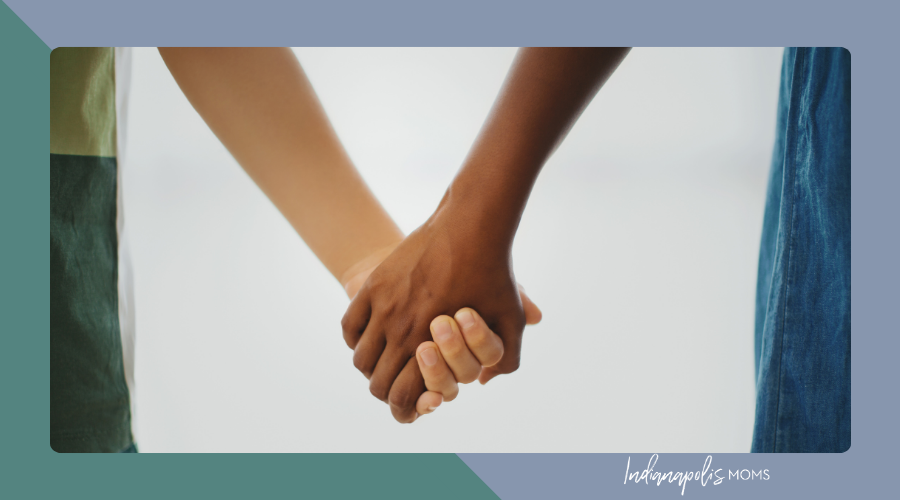
 So far in this series, we’ve listened to stories of microaggressions and exclusion, stories from childhood and teenage years, and how racism shows up in everyday life. We have felt the weight of the “bricks” being carried by those in our community. Sitting with these stories has shifted something in me. I’ve realized that we can’t just listen and then walk away; we have to ask ourselves what it looks like to actually show up for the people we’ve been listening to. In this part, we explore the power of our voices—specifically, what happens when racism is named and when it isn’t.
For a long time, I believed keeping the peace was the kindest way to use my voice, but I’ve realized silence is not love—it’s often just a way to remain comfortable. I keep coming back to how Osheta Moore differentiates between peacemaking and peacekeeping: “The difference is subtle, but subversive. Peacekeeping maintains the unjust status quo by preferring the powerful…Peacekeeping does everything to secure a place at the table. Peacemaking says all are welcome to the table, then extends the table with leaves of inclusive love. Fear drives Peacekeeping. Love powers Peacemaking.
I want to be a peacemaker, not a peacekeeper. I’ve realized that this kind of peacemaking often requires discomfort. Love asks something of us, and often that something is the courage to name what we see and hear. Choosing to speak up—even when silence feels safer—is the first step of peacemaking.
“If you are neutral in situations of injustice, you have chosen the side of the oppressor.” —Desmond Tutu
The following stories invite us to consider how we will respond when we find ourselves in these moments. As we listen to these lived experiences from women in our own communities, we have to ask ourselves: will we stay silent, make “polite” excuses, or find the courage to call it what it is?
Anonymous Contributor
I’ve often felt like I’m loved because people see me as an exception and am therefore the safe one in their eyes. I was the smart kid, the good one.
There’s this idea that Black people all share one monolithic experience, but that hasn’t been my reality. When I went to Spelman, an all-women’s historically Black college, it was the most diverse time of my life. I met people from different countries, religions, and backgrounds. It reinforced what I already knew: there is no single way to be Black.
I believe white privilege is real. It shapes opportunities and assumptions in ways people don’t always see. At the same time, I recognize there are other forms of privilege in my life. I was raised by two educated parents. My father was a physician. My children are growing up in a home that values education and opportunity. To pretend those advantages don’t exist would be dishonest. But acknowledging other forms of privilege doesn’t erase the reality of white privilege—both can be true at the same time.
But privilege doesn’t shield you from racism.
In medical school, there were sixteen Black students in my class—four times as many as the year before. During our first year, two students attended a Halloween party as a “token Black couple,” one of them in blackface. Meetings and assemblies followed. I remember an Asian classmate saying he just wanted to disappear, to blend in. I hated hearing that. I don’t want to be a melting pot; I want to be a stew. I want to be seen as a Black woman. I don’t want to be anyone but me. I love my culture.
As I entered my medical career, I became very aware that being a young Black woman was something I had to pay attention to. There were moments when the lack of trust was evident—subtle questions about whether I was as qualified, or people just didn’t like that I was Black. There’s always that backdrop of needing to be confident in who I am because I know others may not be as confident in me.
There were earlier moments, too. At a dinner gathering, a pulmonologist who had attended Harvard around the same time as my father didn’t believe my dad had gone there. He pulled out his Harvard yearbook and made me point to my father’s photo in front of everyone. I think many people carry heartbreak over moments like that—the feeling of being devalued, of having to prove what others are assumed to be.
As a mother, I’ve seen how early that devaluing can begin. During a Black History Month art project based on I Know Why the Caged Bird Sings, a teacher told our son, “If there’s any time you should be quiet, you should be quiet now. We’re talking about your people.” We met with the teacher and the principal. We wanted our son to know his voice mattered—especially in conversations about his own history. Silence should never be the lesson. That moment reinforced what I already knew: representation, awareness, and language matter. And children are paying attention.
It’s okay to see color. Color is not something to be afraid of. We are unique and wonderful, with different backgrounds. We are more alike than different, but our differences make us who we are.
I love being a Black woman. There’s space for me to love who I am and for you to love who you are. Give everybody time, space, and value. Everybody has worth.
Liz
Living in an educated, upper-middle-class suburb, I thought my Asian children would be protected from racism. I believed racism existed—and I talked with my kids about how to call it out—but I naively believed we wouldn’t experience it in our community.
The first time my son experienced a racist insult was in fifth grade, when a group of white girls chanted “Ching Chong” at him. He identified it as racist, and the school addressed it with consequences. But later, one of the girls received a model citizen award. The messaging felt mixed at best.
Fast forward one year to middle school. My son was hearing the n-word daily. When he spoke up, he was called “chink.” Kids made fun of his eyes, that he’s adopted, and sang “Ching Chong bing bong.” At one point, a group of girls texted him being nice, so he thought they liked him, only to ask if he could cook fried rice for them.
At that point, I went to the school because my son was depressed and hated school. I was told, “This is what middle schoolers do nowadays,” in reference to the racist language—including the n-word. When I asked if parents were being notified, I was told the parents say their kids hear it in music and on social media, and that they can’t do anything about it.
I had to insist that administrators use the word racism to describe what was happening. They wanted to call it being mean or picking on him.
I was shocked that these were the people I live in community with. I now feel more skeptical and guarded with our neighbors.
We pulled my son from school during the last month of sixth grade for his mental health. The following year, he started at an arts and science school in the city. The student body is 51% people of color, and bullying and racism are not tolerated.
His self-esteem and well-being improved remarkably after one semester. Hearing him talk about how the school addresses racism, you can tell how proud and at ease it makes him.
I wish white parents, educators, and administrators could see the difference it makes when children of color know adults have their back and will stand up for them. If white children were taught to speak up against racist jokes and microaggressions, they could change the culture of our schools.
These stories remind us that even today, in 2026, racism is still very real and is still being minimized and excused. We’ve seen that education, social class, and professional success do not shield people from racism and its harm.
We’ve also seen that our response really does matter. Choosing to name racism and discrimination matters. Refusing to look away or choose the easier way out matters. Choosing to stand—and sit with—our neighbors, our friends, our loved ones, and our communities matters. This isn’t a project to be completed or a box to be checked; it’s a commitment to sit in the discomfort for the long haul.
If we believe our children—and all people—deserve schools and communities where they feel safe, valued, and protected, we must decide what we will do with the stories we’ve heard. We cannot let them end here. Will we choose to show up and speak up? As Martin Luther King Jr. reminds us, “Our lives begin to end the day we become silent about things that matter.”
In the fourth and final part of this series, we will reflect on where we go from here.