 Okay, I have a confession to make. I am not good at being a beginner. There. I said it. But that’s exactly where signing up for taekwondo with my kids put me.
I’ve spent the better part of two decades building expertise. I have an MBA. I hold my SPHR certification. I’ve consulted for companies on HR strategy, coached women through some of the most pivotal moments of their careers, and I have a book coming out. Expertise is kind of my thing. When I choose to do something, I generally show up knowing what I’m doing, or I spend a significant amount of time making sure I will before I walk through the door.
So, when I decided to sign up for taekwondo with my boys? Let me tell you, that was a whole moment.
Because here’s the thing about taekwondo: there is no faking it. You either know the form, or you don’t. You either land the kick, or you don’t. We take classes with Master Yoo (can we or should we include the link?), and I’ve seen his patience with my boys and with me. There’s a balance of encouragement with the corrections that inevitably happen, and I can feel my confidence growing every class.
More often than not, in those early weeks, I absolutely did not. I stumbled. I went left when I should have gone right. I watched my kids execute moves I was still fumbling through, and every instinct in my body wanted to laugh it off, change the subject, or find literally any reason to be somewhere else.
But I stayed. I kept showing up. I kept getting it wrong, trying again, getting it a little less wrong, and eventually getting it right.
And here’s what I didn’t expect: my boys were watching every single second of it.
Not in a judgmental way. In a learning way.
We talk a lot about wanting our kids to be curious. To be lifelong learners. To try new things without being paralyzed by the fear of not being perfect at them immediately. But what are we actually showing them about what that looks like? Because if they only ever see me in the spaces where I’m already confident and capable, what I’m accidentally teaching them is that the goal is to only do things you’re already good at. That mistakes are something to hide. That struggle is something to be ashamed of.
That is the last thing I want for them.
I want them to try the thing they’ve never tried. To raise their hand in class even when they’re not sure of the answer. To take the new job, pursue the unexpected opportunity, walk into the room where they’re the least experienced person and stay anyway. Because growth lives in that uncomfortable, humbling, slightly embarrassing space. And I needed them to see me live in it too.
Here’s what else I’ve been thinking about, though, and this part surprised me a little: this isn’t just about the boys as kids. It’s about the men they’re going to become. The partners they’ll be someday. The teammates, the coworkers, the friends.
Because the partners and people who are the most supportive, the ones who can sit with someone they love in the middle of a learning curve and say I see you, keep going, are the ones who know what it feels like to be there themselves. When my boys watch me struggle and try and struggle again and eventually land it, I’m not just teaching them about taekwondo. I’m teaching them that the people they love will need grace in their hard and humbling moments. And that the right response is not to look away; it’s to stay in the room.
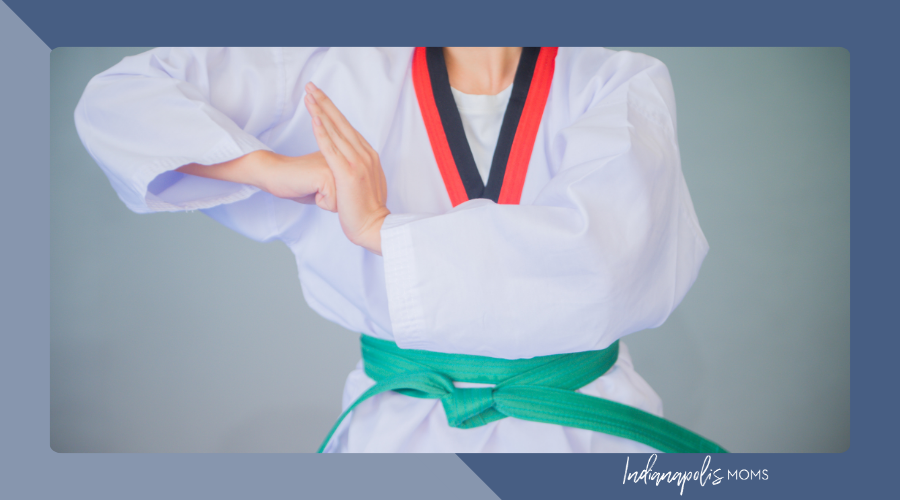
Master Yoo often says that a black belt is a white belt who never gave up. I’ve worked my way up from a white belt to a green belt, officially out of the beginner ranks. And I’m proud of it.
I plan to keep going to taekwondo with my kids until we all have our black belts. They’ll probably earn theirs before me, and that’s ok.
Some days all any of us can do is just be brave enough to begin. To mess up in front of the people who love us most and trust that the lesson lands somewhere deeper than the mistake.
It turns out that being a beginner at taekwondo with my kids might be the most expert thing I’ve ever done.