 This is a longer post, but in celebration of Mother’s Day, I wanted to put this out there. It has been the hardest thing I have ever written. I titled it, “Ode to my Grandma.” I miss her every day, and love her just as many.
I have both a daughter and a son, both of whom I love more than words can say (even me, to whom words come easily). When you have one child, you cannot imagine loving a second the same way. Then your second one comes and turns your world upside down, and by the time you find your bearings, you realize there is enough love to go around, that love is not a finite commodity, that your capacity for it doubled when your family size did.
Our little one, our daughter, came three weeks early, then spent the first two earthside either sleeping so soundly that her mouth popped open and she made little snoring sounds or looking around with her slate colored eyes set in a way that was very judgmental and seemed more than a little disappointed like: You pulled me out for this?!
While she was coming to terms with this world (I think now she was just in deep planning stages for how she would makeover society), many of our friends or moms that I talked to began making comments like “Oh, you just wait,” or seeming to wish us luck for our sanity and general well-being as our baby daughter got older and older. It seemed to be generally accepted among the mom community that girls are just different. This narrative of course pairs with the discourse about girls needing their streaks of willfulness and determination in the face of a society that still tends to lean towards the patriarchy, the idea of women being emotional, the gender pay gap and the double burden of womanhood/motherhood, the mountains still left to scale in the face of adversity and prejudice especially in these days of decreasing DEI and affirmative action.
Are girls just different? It’s complicated. The nature-versus-nurture argument informs many of us and colors our perceptions of childhood and the adults our children become.
Having two children, though, has challenged my long-held beliefs about nurture versus nature. We have two very, very different children who have been raised in the exact same surroundings and with the same privileges. To neither confirm nor deny the nature of girls and whether they are (in the raised eyebrow look that so many moms gave me) different, I have noticed a few things at the park. What resonates are the little girls who follow their moms, moms who are pushing a baby stroller packed down with a younger sibling and a diaper bag and everything else an excursion out mandates, who are also pushing their own stroller with their own little babies and diaper bag: the same look of pride and resignation on both generations’ faces. The little girls who direct the groups of kids, who keep an eye on younger kids while their moms walk endless circles to get a newborn to sleep, the ones who I have seen pass around bottles of Germ-X and allot each child a conservative amount on each palm and instruct them on how to rub it in.
Here is what I have realized.
Little girls are us. It’s like the Bluey episode where Bingo orbits back to the sun and sleeps soundly basking in the light: as much as our daughters are the sunshine in our lives, we, as their mothers, are the celestial body that lights their days, that guides them, that energizes them, nurtures them, and sets them on their path. Our daughters are us. We are our moms. Our moms are their moms. A true matrilineal line of lessons, leadership, and love.
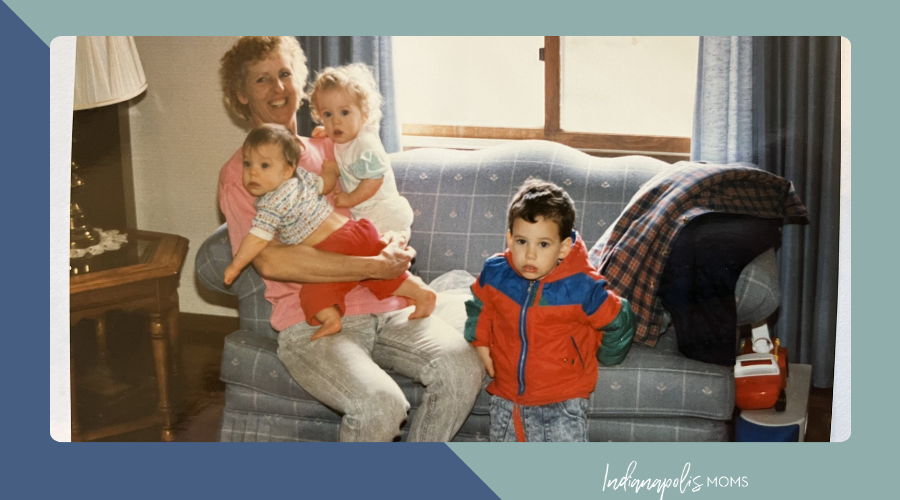
My grandma passed away three years ago this September. For a long time, it amazed me that such a small person could leave such a gaping hole. But in many ways, my grandma was larger than life. In my own, she had transitioned from “Mee-maw” (my brother as the first grandchild christened her in the fall of 1990) to “Grandma” (this one, I think, is where her true identity lay: I remember her straightening up to her full height of 5’10 [this is before her absolutely debilitating osteoporosis and arthritis, then later, lung cancer, which reduced her physical figure to around five foot tall and eighty pounds heavy but her spirit and personality remained the improbable huge measurement of the matriarch of our sprawling family] and telling my other grandma, my dad’s mom who we called “Grandma D” “No, I’m Grandma! JUST Grandma” and walking away like she had secured her position on a pinnacle that only she knew existed). Twenty-nine years after her first act as “Mee-maw,” my grandma became “GG”: great-grandma with the birth of our son. Three years and nine months later, she was gone.
I think that being “Grandma JUST Grandma” was considered by my grandma to be her crowning achievement. And really, Grandma had earned this title. She was the three-day-a-week caretaker for my siblings and me from the time we were born, meaning she made the transition from just caring for my brother to caring for him and a set of 6-week premature twins when we surprised everyone on the Fourth of July a few years later. She was wonderful. Many memories from my early childhood took place at her house, which were filled with the sound of her voice and laughter. I can still smell her cotton-candy body spray mixed with the coffee always close by. I can still feel her hugs. She is the true testament that what we do for those we love far outlasts other accomplishments, that a child is a legacy, and our love for them as mothers, or in this case, grandmothers, is eternal. To be a mother is to be everlasting: we will exist even when we do not.
The months directly following the day that Grandma died, I missed her so much that the grief felt like it was an actual, physical ailment. It seemed like my brain was existing on two different planes: one in which my grandma was still here tucked safely in her house three hours north watching the deer from her porch swing, the other replaying my grandma’s last days, her funeral, the absence of voicemails with her trademark, “Hey, Honey!” with the hey drawn out and the honey pronounced in a way that it was clear she was smiling when she said it, the absence of my grandma on this earth.
As the earth continued to spin, my grandma revealed herself in discreet ways, and I realized that, although gone, a part of her lingered here: the best part, the part that loved my kids, the part that loved me. The first was when a small pair of yellow rain boots (stashed away because they were the wrong size and reminded me a little too much of the Stephen King book “It”) toppled out of a closet and landed heels down on the floor, looking like they were ready to be stepped into. My son, squeezing his feet out of his old pair of rain boots, WAS in fact ready to make use of the new (well, new to us, they were from a garage sale) yellow ones. It had rained throughout the night, and our woods were flooded, perfect for stomping in some puddles. As my son made mud pies and my little one watched twigs twirl in the flowing water (yes, it is a terrible drainage issue), I considered the boots he had on his feet, how they had arrived right at our moment of need, and how they had allowed these priceless childhood memories (or at least, guaranteed mud-soaked laundry) to exist. I remembered those boots: my grandma had picked them up for our son when the boot was about half the size of his body: on that day, though, they were the perfect size. I felt her then, and not just through the yellow rainboots that I bet had a 25-cent sticker on them that was reduced to a nickel with my grandma’s take-it-or-leave-it, junkyard dog, garage sale ways. I felt her in myself, of what I was doing: watching my kids play outside and celebrating their splashing, their messy play, their imagination. How many times had Grandma done the same with me, had buttoned the top button of my jacket and sent me out into falling leaves, or provided a carrot from the fridge for a mostly slush, slightly dilapidated snowman? I had so many memories of calling out to her, “Grandma, look!” and her being interested, interactive, and invested in wherever I was showing her. Now, here I was, doing the same. She was gone, but her love remained, manifesting in my own style of mothering. In this way, when my kids sloshed over to me to give grimy hugs, the hugs they received back were from GG as well. And the grief subsided a little bit with the sound of their laughter.
I began to notice more and more connections like this. My kids, for whatever reason, became fascinated with the toys that GG had given them. Our little one talked constantly on the chatter phone that was passed our way after spending the 1970s in the toy chest of my mom and uncle (the same one that our oldest used to crawl over to, pick up, and say, “It’s GG! Hi!” much to the hilarity of actual GG who, in his defense, did spend A LOT of time on the phone). My son wound and unwound the line from a tow truck she had found at a church sale, hauling anything that could be attached to the tiny hook. My kids and their friends from the neighborhood carted item after item: rocks, sticks, leaves, dirt, and our dog (unsuccessfully) in a small red wagon that my grandma had been so pleased to find (and get a good deal on). Every time, it felt to me like my grandma was playing with my kids, that even after everything, she was still GG and doing her best to keep the kids happy. She was still here, still doing what she loved with who she loved. She was still earning that “Just Grandma” title.
My grandma was a gregarious person. She had a huge friend group and was constantly dropping off cookies somewhere and receiving homemade rolls from somewhere else. The phone was always ringing (back when landlines were a thing), and she did use Facebook for a time (but referred to any action taken on the platform as “poking,” which gave it a slightly sinister, inappropriate feel). She, in her own telling, enchanted many a man with her “baby blues,” made even more pronounced by the swab of bright blue dollar store eye shadow she put on each eyelid daily. She made a lot of jokes at her expense, but anyone in the general vicinity was a prime target too: she kept us on our toes, she kept us laughing, and importantly to her, she kept us fed.
At the anniversary of her death, we pulled together to give Grandma what she had requested in the years preceding her death: a true celebration. My parents hosted, we all brought dishes to share with one another, and really, we all brought pieces of Grandma. My cousins, with their carefree and quick-to-laugh natures, their razzing of each other, and self-deprecating stories. My uncle, with his caring gaze on my grandpa, his arm steadying my grandpa, who was trying his best but struggling against the loneliness of his days. The biggest piece of my grandma, however, may have been brought by my mom.
As the celebration of life started and everyone arrived, her own grandkids arrived two by two. The world stopped when she greeted each child, their small faces lighting up in the presence of their “Yaya.” She helped cut up pieces of food, helped secure kids into booster seats or high chairs, rocked a small grandchild while her mom ate, and comforted another after a fall. All of these actions mirror images from thirty-four years before, Mom, a young woman watching her mom with her first grandchild, the practice perfected over the years as more and more babies arrived. We celebrated Grandma, our memories, and her life. But Grandma was there, she was there in all of us. She especially was there in her own daughter. Motherhood is eternal.