
 I didn’t grow up playing many family games, but my husband did, so 15 years ago I had to learn to play euchre if I wanted to marry him (in hindsight, that’s probably dramatic, but I wasn’t taking any chances!). If you’re unfamiliar with euchre, it is a 4-player card game where you and your partner try to win the most tricks and beat the other team. It seems to be a staple here in Indiana, and we now play occasionally with several friends. So, started my love of games and competition; we accumulated tons of board and card games in our early years of marriage, and even more during the pandemic.
After our sons were born, it just seemed natural to get them started playing games. When my oldest was two, we bought Little Cooperation. It’s an extremely simple game where you roll a die and attempt to get four cute little animals across a river into an igloo. It introduced them to board games, taking turns, rolling dice, and it’s a cooperative game, so you either win or lose together. We loved it, and it’s our go-to gift for little ones now. After Little Cooperation, we branched off into slightly more difficult games made by Peaceable Kingdom.
Luckily for me, my boys loved playing games; their interest took off, and we got as many games as we could. Two favorites for years were Peaceable Kingdom’s Race to the Treasure and Educational Insight’s Sneaky Snacky Squirrel.
I was amazed at how quickly they grasped these games and how much I saw them learning. I credit their love for games and learning to these early years of game playing; they felt so included and had so much fun when we would all sit down and chat while playing games as a family.
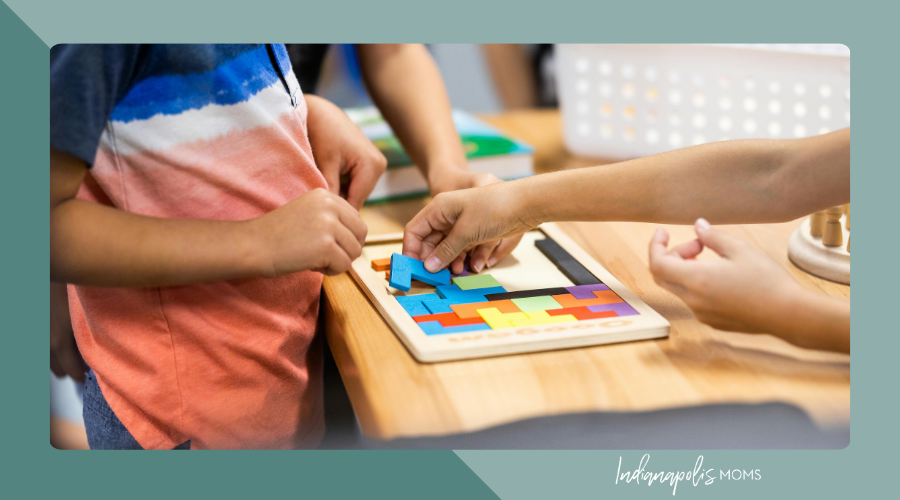
When I decided to homeschool, I pictured sitting at the kitchen table with my boys, books open in front of them, a coffee and an answer key in front of me, maybe some calming music playing in the background. I don’t know what I was thinking; my sons are currently in kindergarten and second grade, and I don’t think I could get that scene to unfold for a million dollars. Because of this, you can probably imagine how thrilled I was when I discovered gameschooling. Gameschooling has been our biggest and most fun focus the last three years. If you’re like me, you’ve probably never heard of gameschooling; in fact, I don’t know that it has an official definition. Essentially, gameschooling is just what it sounds like-using games as school. Specifically, we use board and card games (along with made-up games using everyday items like chalk, contact paper, or nerf guns) to teach kids valuable life and school skills in an abstract way. If I say “Hey boys, want to do a math worksheet?” the immediate groans and whining is enough to hurt my ears, but if I say “Hey boys, want to play a game?” they immediately run to the closet to pick out a favorite.
I spoke with Katie White, a local mom who also utilizes gameschooling, and she recommended several games I had never heard of and will absolutely be looking into. With her early elementary schoolers, she uses Miss Brain’s Cool Math Games extensively. She said they are easy to learn, easy to use, and her kids love them.
My six-year-old has insisted he wants to be a “video game tester” ever since discovering the Press Start! books from Scholastic. While researching video game careers, I found Bloxels, and he has since built an entire real video game of Super Rabbit Boy. One aspect of Bloxels that I love as a parent is that it is a video game, but not entirely on the screen. You use real blocks (the Bloxels) in a real grid to create the characters and landscape of your game. I then take a picture of the grid in the Bloxels app, and it brings it to life on screen where he can play what he created. Other highly recommended coding and video game programs I have heard of are Scratch and Scratch Jr., Code Sparks, and Minecraft Education.
I get that board games can be expensive, so we utilize lots of card games, made-up games, and just use our brains and move our bodies as well. A well-known Instagrammer, Susie from Busy Toddler created an extremely affordable homeschool curriculum that has wonderful content. One activity my kids still talk about from her Solar System unit was a “Planet Distance Walk” where she scaled the distance between all the planets in our solar system into footsteps! We spent a beautiful fall morning walking around our neighborhood drawing the planets and learning how huge our solar system actually is- she’s brilliant!
I could go on for days about the educational impact of games. The games I mentioned above teach my boys so many useful skills: logic, cognitive thinking, math, fine-motor, communication, strategic thinking, visual discrimination, executive function, and so much more. If you’re looking for something to switch up the monotony of standard old worksheets and lessons, give gameschooling a try and let me know what you think.