
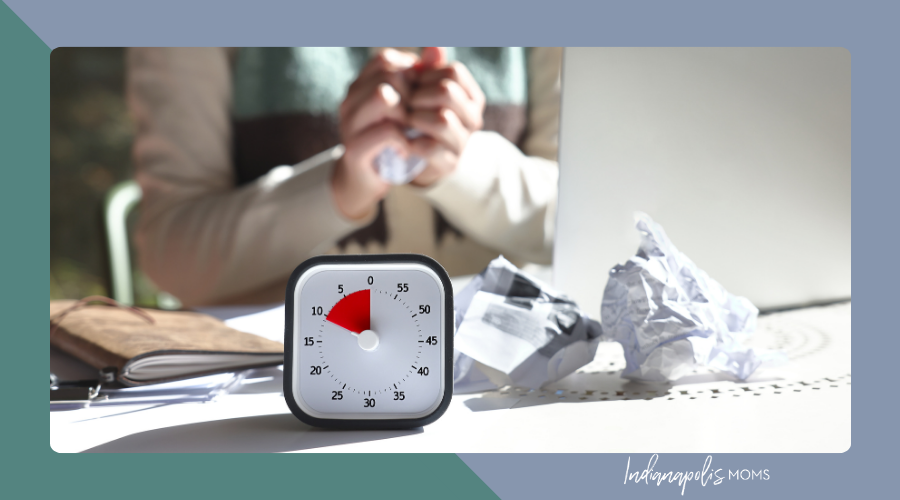
 A couple of months ago, I bought a $15 rainbow-themed visual timer for my 6-year-old daughter as a practical solution to a very specific problem: her morning dawdling and my morning frustration. Getting her ready for school and out the door on time had become our biggest hurdle, regularly resulting in tears and raised voices from one or both of us.
I realized I needed a way to make the passing of time visible and understandable to her without my constant (and increasingly disgruntled) reminders. I needed her to grasp how much time she had before we needed to leave and realize the faster she got ready, the more time she’d have to enjoy all her fun before-school distractions.
So I introduced the timer, and for the most part it’s worked. She can see the minutes on the timer dwindling, and she fairly quickly picked up on tradeoffs. The longer she lay in bed with the covers over her head, the less time she had to chase around the dogs, listen to a Yoto book, or watch a Dr. Binocs video. Conversely, if she focused on getting ready quickly, she had more time to play. But, maybe most importantly, it turned our mornings into a game, a race, if you will. Can she beat the timer? Only time (literally) will tell!
Even though I would call this a parenting success, what I definitely didn’t expect was that these same tricks and games with a cheap visual timer could work on me, too.
I work a hybrid schedule – two days in the office and three days from home. And while no two days are the same, I have realized that sometimes my own workday habits aren’t all that different from my daughter’s mornings. I’ll sit down to focus on editing a document and within minutes, I’ll be checking email. Then a Microsoft Teams notification will pop up, and I’ll get into a conversation with a colleague about an issue. I’ll “quickly” look something up, which then somehow turns into at least a 30-minute ride on a completely different train of thought. It then takes me at least another 30 minutes to get refocused on the original task of document editing, and, whoops, well over an hour has passed and it’s time for me to join a meeting.
No, I’m not crawling back into bed and putting the covers over my head (as much as I may want to). And all of these things – meetings, answering emails, responding to chats – are a part of my job. But, just like the minutes in my daughter’s mornings, it feels like time can pass me by in unproductive ways without even realizing it.
So one day while working from home, I decided on a whim to test out the infamous rainbow visual timer. I grabbed it from her room, placed it on my desk, and set it for 45 minutes. I told myself I would focus on one task and one task only. No email. No phone. No Teams messages. Those things could wait while I got as far as I could on the document before the buzzer went off. Once it did, I could take a 15-minute break to do whatever I wanted – scroll social media, answer emails and chats, get a snack, switch over the laundry. (If this sounds familiar, it’s because it closely mirrors the Pomodoro Technique. While I’d heard of it before, it was always this abstract concept I didn’t quite grasp. Beats me how a rainbow timer made it real.)
It turns out there’s something incredibly powerful about putting a time limit on your focus and giving yourself a treat as a reward. When I know I only have to concentrate for 45 minutes, and then I can take a break, it automatically feels doable. It’s just 45 minutes. You can do anything for 45 minutes, right? And what’s interesting is that, more often than not, I don’t want or need the break. By that point, I’m in the zone, hitting that elusive flow state where I’m making significant progress and don’t want to stop.
Even more interesting? The rainbow timer hasn’t just helped me focus on my productivity on work-related tasks. I’ve also started using it for chores around the house, especially those I typically find all the reasons to avoid. For example, folding and putting away laundry is one of my most hated tasks. Obviously, it’s not complicated or mentally taxing. It just feels endless and like it takes forever.
You know what a timer helps you realize? It rarely takes as much time as I think it will, and the “forever” I’ve been avoiding is really just 25 minutes of folding. Other times I set the timer to see if I can beat the clock while putting my clothes away. As it does for my kid, the visual timer helps me perceive actual time. It takes something I’ve built up in my head as a dreaded, time-sucking chore and shrinks it back to a manageable size while also turning it into a game I can win.
Does this sound absolutely ridiculous? That’s because it is! To be clear, I am admitting the same rainbow timer that tricks my daughter into getting ready for kindergarten also helps me be productive at work and home as a 40-something-year-old professional. There is absolutely something both humbling and hilarious about this. Probably because we like to think that, as adults, we’ve outgrown these simple behavioral tricks and really just need more discipline or a better system. Yet, in reality, our brains really aren’t much different from kindergartners’. We all respond to boundaries, incentives, and challenges. I mean, who doesn’t like winning a game, even if the game involves matching socks and putting away underwear?
So, whether it’s for you, your kid, or both, I highly recommend investing $15 in a visual timer. It certainly has helped me bring my time back into focus. (And, if you do buy one, let me know so we can do a laundry race!)